
Why a wet towel on your head does not work
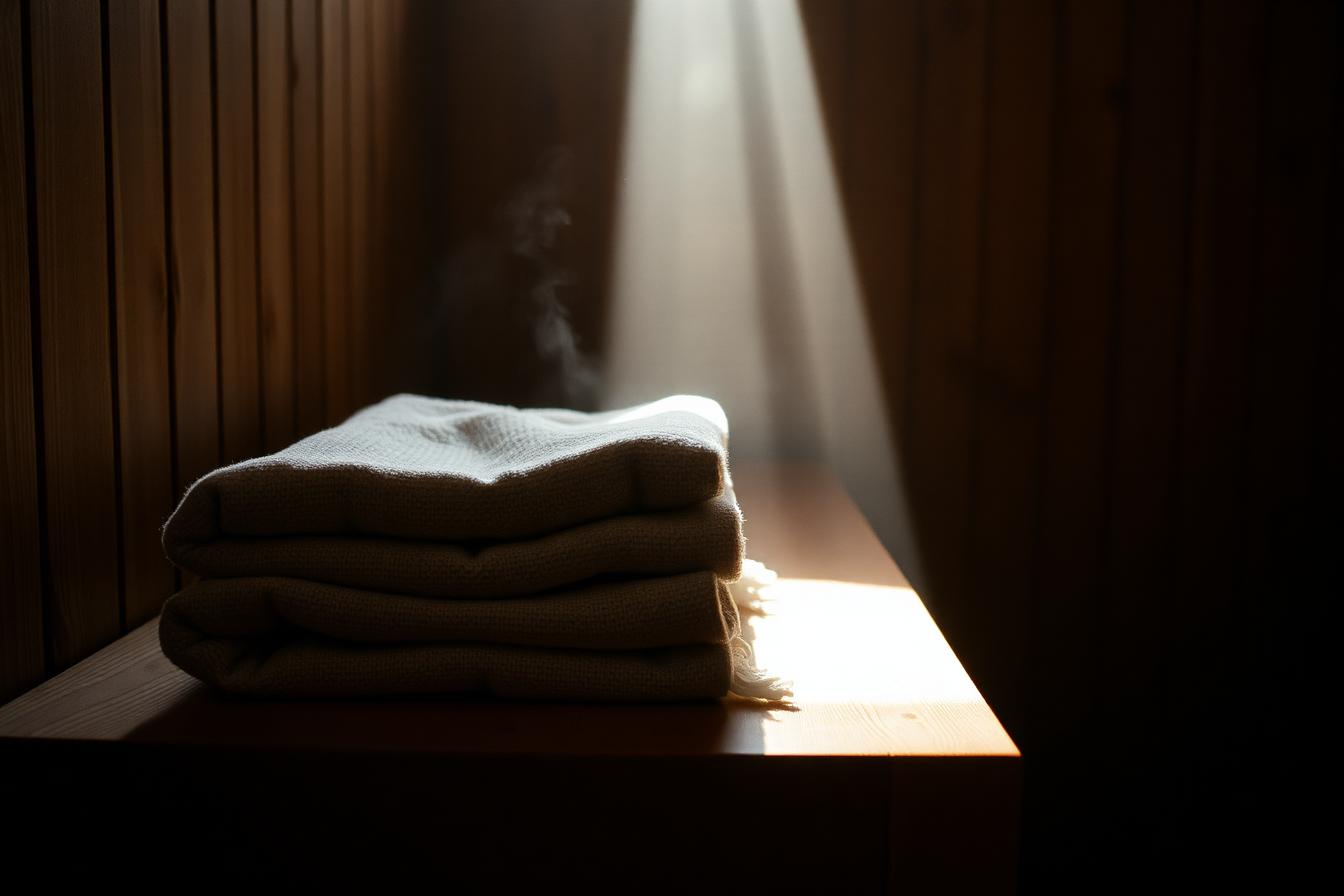
Walk into almost any UK spa sauna and someone will have a wet towel draped over their head. It is a reasonable instinct — cold and damp on a hot head feels like relief. It is also the one head covering that reliably stops working before the session does, and the reason is not opinion. It is the difference between insulating and conducting.
What the towel is actually doing
A head covering in a sauna has one job: slow the rate at which the hottest air in the room reaches your scalp. Heat rises, so the air at head height on the top bench is the hottest layer in the space — often several degrees above the reading on the wall thermometer.
Insulation works by holding still air inside a material. Dry wool felt is largely trapped air held in place by a dense, disordered mat of fibre, and still air is one of the poorest conductors available. Water is not. Water conducts heat roughly an order of magnitude better than the still air it displaces, which is why a wet sleeve burns and a dry one does not.
So a soaked towel is not a barrier. It is a thermal bridge with a cold start. It feels cool for the first minute because it is cool, and then it behaves like a warm compress held against your head.
The failure sequence
Four things happen in order, and most people only notice the fourth:
- Minute one: evaporative relief Water leaves the towel, taking heat with it. This part genuinely works and it is why the habit persists.
- Minute two to three: the water heats up In an 80–100°C room the towel reaches room temperature quickly. Now it is warm water in direct contact with skin, conducting heat inwards rather than blocking it.
- Minute four onwards: it dries out A thin cotton towel in dry heat loses its water fast. What remains is a loose weave with very little trapped air — a poor insulator even when dry.
- Then it gets heavy and slips So it comes off, goes back in the bucket, and the cycle restarts. That interruption is the real cost: the session stops being continuous.
Why felt behaves differently
Felt is not woven. Fibre is matted together with water, heat and pressure into a single dense material, which is why it holds structure and air at the same time. Wool also absorbs a significant amount of moisture into the fibre itself before the surface feels wet, so it manages sweat without becoming the conductive layer a soaked towel becomes.
The practical difference is duration. A dry or lightly dampened felt hat holds its insulating behaviour for a full round. A wet towel gives you its best minute first and degrades from there.
We are not claiming felt makes heat safe or extends how long anyone should sit. It removes one specific limiting factor — the head being the hottest part of you — so the session ends when you decide it should rather than when your scalp does.
If a towel is what you have
Use it, but use it deliberately. Wring it out properly rather than leaving it soaking, so you get evaporative cooling without a layer of hot water against the skin. Sit lower on the bench, where the air is cooler. Re-wet it between rounds, not during them.
And treat the cold interval as the thing that actually cools you. Rinsing the head under cool water between rounds does more than any covering can, because it removes heat rather than slowing its arrival.
Common questions
- Does a wet towel on your head keep you cool in a sauna?
- Only briefly. While water is evaporating from it, the towel cools. Once the water reaches room temperature it conducts heat towards your scalp instead of insulating against it, and once it dries a loose cotton weave holds very little still air. The effect lasts a minute or two, not a full round.
- Is a wet towel better than nothing?
- For the first minute, yes. Over a full round, a dry towel folded thickly is more useful than a soaked thin one, because trapped air insulates and hot water does not.
- Should a sauna hat be wet or dry?
- Dry insulates more; lightly dampened feels cooler for longer. Both are used. What does not work is soaking it — that turns an insulator into a conductor, which is exactly the towel problem.
- Why do Finnish saunas use felt hats instead of towels?
- Because felt is a dense mat of fibre holding still air, and it keeps behaving that way through repeated heat and moisture cycles. In Finland, Estonia, Latvia and banya culture the hat sits on the same shelf as the ladle — standard equipment rather than an accessory.
- What about a cold flannel on the face?
- Different job. That is comfort and evaporative cooling for the face, and it works on the same short timescale. It is not a substitute for insulating the crown of the head.
This is the kind of question the Lab exists to answer: what the material is actually doing, and where the common solution quietly fails.